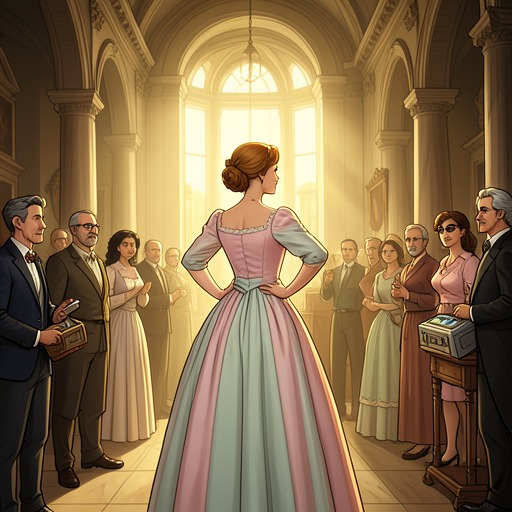
Clarissa Dalloway
Mrs DallowayClarissa Dalloway is a London hostess who turns the ordinary work of preparing for a party into an attempt to draw separated lives together. Moving through the city and her house on a June day, she is at once absorbed by its public movement and unsettled by her own aging, illness, and eventual death. Her party matters not because it wins approval, but because she understands bringing people together as her distinctive gift: a fragile answer to loneliness that cannot erase the privacy between one person and another.
Identity and Inner Life
Clarissa’s day begins with an errand and a household in motion. She decides to buy the flowers herself, while Lucy has substantial work to manage at home, including doors taken off their hinges for Rumpelmayer’s men. The contrast establishes two sides of Clarissa’s life: the arrangements through which a household and a social occasion are made, and her own desire to experience the morning directly. The fresh air recalls her youth at Bourton, when, at eighteen, she burst through the French windows and went outside. That memory brings back Peter Walsh as well, in the remembered teasing remarks that outlast the disappearance of so many other details.
In London, Clarissa’s instinctive interest in other people is a central part of how she understands herself. She believes she can sense a person’s character almost as soon as they enter a room, and remembers the many houses and people encountered through a life of visits, dances, and journeys home across the park. Yet her attention is not confined to her social circle: what she loves is what is in front of her now, including an ordinary woman in a cab. She wonders whether the self ends entirely at death, then finds some consolation in the thought that lives continue in other people and in the shared city. She imagines herself as part of people she has never met, spread between those she knows, much as mist lies among trees.
That sense of outward connection coexists with a painful awareness of being unseen. Clarissa imagines how she might have wished to be different: like Lady Bexborough, imposing, stately, politically interested, and established in a country house. Instead, she sees herself as slight, with a small, birdlike face, though she takes care over her bearing, hands, feet, and clothes. Looking at a Dutch picture, she feels that her body has become almost nothing, and that the possibility of marrying and having children lies behind her. In public she is Mrs. Richard Dalloway, not quite Clarissa as she knows herself: a social identity that gives her a place while also making her private self feel invisible.
Clarissa is in her fifty-second year and has been changed by illness. When she looks into her dressing-table mirror, the present morning gathers earlier mornings into a single moment, and she sees the face of the woman who will give a party that evening. The effort to hold this moment against time does not make age disappear. It makes her sharply conscious of the life still ahead—June, July, and August—and of the bodily vulnerability that shadows her sense of renewal.
The Work of Hosting
For Clarissa, a party is not simply a display of social status. When she is annoyed that Lady Millicent Bruton has not invited her to lunch, she recognizes how easily vanity and the wish to be liked enter her actions. Later, thinking about the criticisms of Peter Walsh and Richard Dalloway, she distinguishes her own purpose from what they suppose: she does not host merely to surround herself with famous people or to seek excitement. What she likes, she concludes, is life.
She explains the purpose more fully in her own mind. People live separately across London—in South Kensington, Bayswater, and Mayfair—and she feels their existence as well as the waste of their isolation. If she can bring them together, she does so. The party is an offering: an act of combining and creating, even though she cannot name a recipient for it. She regards this ability as her gift, especially because she believes she has little else of importance to offer. Her self-criticism is unsparing: she says she cannot think, write, or play the piano, and admits her confusions, love of success, dislike of discomfort, and wish to be liked. The value of the gathering lies not in making her flawless, but in making connection possible.
That social purpose depends on practical work. The green evening dress has been torn where someone trod on its skirt at the Embassy party. Clarissa decides to mend it herself, despite the servants’ workload, and carries it to the window before bringing her sewing to the drawing-room. Lucy offers to help. Clarissa thanks her repeatedly, recognizing that her servants help her become the gentle and generous-hearted person she wants to be. The dress also has a history: it was made by Sally Parker, whom Clarissa remembers as a genuine artist, now retired and living at Ealing. A familiar garment, careful repair, and the labor of the household all enter into the public self the party will present.
The party’s social promise is set against the solitude that can follow even a day full of encounters. After Lady Bruton has not asked her to lunch, Clarissa goes upstairs feeling excluded and diminished. In the bedroom and bathroom, she lays aside her yellow hat and confronts the emptiness she associates with the heart of life. The pause does not cancel the party or her wish to connect people; it shows the private cost that social grace can conceal. She can create a meeting point for others and still experience herself as alone.
London, Time, and Encounters
Clarissa’s city is made from movement and sensation as well as buildings. Having lived in Westminster for more than twenty years, she feels a hush before Big Ben strikes. Its warning gives way to the hour, which she experiences as irrevocable; the sound then seems to dissolve through the air. Against that measured time, she loves London’s immediate life: traffic, carriages, omnibuses, vans, pedestrians, bands, street music, and an aeroplane overhead. The city is not merely a backdrop for her private reflections. Its sounds and crowds keep interrupting and enlarging them.
A sudden explosion outside Mulberry’s makes Clarissa jump. Passers-by turn toward a motor car stopped opposite the shop; they catch sight of an important-looking face behind dove-grey upholstery before a hand draws the blind. The brief, obscured spectacle draws public attention without giving the crowd a reliable explanation. Later, an aeroplane writes white smoke across the sky, prompting people below to look up and try to decipher its changing letters. Clarissa’s London is thus a shared field of attention: strangers witness the same disturbances, but what they think they have seen remains uncertain.
A later street encounter shows how readily Clarissa’s presence can become entangled with another person’s expectations. Peter follows a woman through the crowd, imagining a daring, romantic role for himself as he pursues her across Piccadilly and up Regent Street. People repeatedly obstruct his view. The woman continues across Oxford Street and Great Portland Street, then enters a house after a brief look in his direction. Clarissa’s reminder about her party remains in Peter’s mind as the encounter ends. The scene makes the city’s connections fleeting: people can cross one another’s paths, read significance into a glance, and still part without a conversation.
An earlier conversation with Peter gives Clarissa’s sense of connection a more explicit shape. They used to explore London from the top of an omnibus and return with finds from the Caledonian market. She had argued that a person was not only located here or there, but could feel herself everywhere. To know someone, she thought, one had to seek out the people and places that completed them, including strangers and features of the landscape. That expansive idea helps explain why a party seems meaningful to her: identity is not sealed inside one person, even if complete understanding remains out of reach.
Relationships and Social Judgment
Peter Walsh remains part of Clarissa’s inward life even when he is absent. Her memories preserve his sayings, his eyes, his pocketknife, his smile, and his grumpiness, while his letters from India seem dull to her. His return is therefore anticipated less through correspondence than through remembered manner and speech. She also recalls that she wanted his good opinion and that his words, including his judgment that something was sentimental or civilised, have continued to shape how she assesses herself.
Clarissa’s feelings about Peter are bound up with her awareness of time and change. Before he returns, she wonders whether he will think she has grown older; she knows that since her illness she has turned almost white. The fear is not just about appearance, but about being seen by someone whose judgment has mattered to her. Elsewhere, she recalls the young people she and Peter once were, full of theories about the dissatisfaction of meeting people every day and then not seeing them for months or years. Their conversations identified the limits of casual acquaintance without solving them.
Her relations with the people closest to her also carry tensions that cannot be reduced to affection or hostility. Richard’s judgment of her parties troubles her because he thinks excitement foolish when it is bad for her heart; Peter, she believes, thinks she likes imposing herself and gathering famous names. She considers both judgments wrong, though she understands how they might arise from what is visible. Her defense is inward and difficult to communicate: the party is her way of affirming life and bringing scattered people into contact.
The Bradshaws’ arrival at Clarissa’s party brings news of Septimus Warren Smith’s suicide into this social space. Clarissa is disturbed that death should be discussed at her gathering, but she cannot dismiss the report as merely an interruption. She imagines the consequence of his fall and asks herself why he did it. His death confronts her with an act of absolute separation in the middle of the occasion she had made to connect people.
Death, Return, and Significance
Clarissa’s first response to Septimus’s death is to withdraw from the crowded rooms and think alone. She compares his death with her own small gesture of once throwing a shilling into the Serpentine: he has relinquished something immeasurably greater. She recognizes that the guests will continue living and that she herself must return to them. The movement away from the party is brief, but it allows the news to alter the meaning of the gathering before she goes back.
Clarissa interprets the young man’s suicide as both defiance and attempted communication. People, she thinks, cannot reach one another’s centre; closeness can give way to distance, rapture to solitude. Death seems to her to preserve something that daily life lets fall away amid corruption and chatter. Her reading does not erase the irreducible difference between her experience and Septimus’s, nor turn his death into a simple lesson. It shows instead how urgently she searches for meaning in an event that has entered her party from outside her own circle.
The return to the guests completes, without resolving, Clarissa’s effort to live among other people. Her party can gather lives that otherwise remain dispersed; it cannot make every private self fully known, protect anyone from illness, or settle what follows death. Big Ben’s hour continues to divide the day, while Clarissa’s attention moves among remembered relationships, present encounters, and imagined connections beyond her immediate company. Her significance lies in that tension: she treats social life as a genuine offering, even as she recognizes that connection is partial, precarious, and made anew in time.